Game Day Inside Peek
9/8/2006 12:00:00 AM | Football
By Scott Latta
UA Media Relations
For the
Game day preparation is a seven-day-a-week event for the group, a group that is charged with keeping the Tide healthy and, when injury occurs, providing the best care and rehabilitation anywhere. It's a role that requires them to constantly be prepared and ready for just about anything that may happen.
Part of being prepared requires the athletic trainers to constantly keep their eyes glued to the field and the players. That's because, often times, the key to treating an injury is seeing how it happened.
"We watch all the games from our particular perspective looking for any possible injuries," head athletic trainer Rodney Brown said. "If you see an injury happen you get so much more information that can help you make an accurate assessment.
"I probably get to see on average a half to two-thirds of the game when I'm not going back to check on a kid. We always try to have one member of our staff always watching the game, and I try usually to make that be myself. If something happens and I can't do it myself, I'll usually delegate it to one of the assistants."
Their eyes watch the Tide players not only on game day but each day at practice as well. Four Certified Athletic Trainers work daily with the football team and coaching staff to ensure that all measures have been taken to keep athletes healthy and ready for games. During the week, these staff members report to work in the training room around 6:30 a.m. Players will begin coming in to the training room to receive scheduled treatments around 7:00 a.m., before they head to classes. Rehabilitation and evaluation is done in the afternoons before practice, during which the training staff, as well as
"We have players that are asthmatic, and we monitor their use with their inhalers. We have guys that take blood pressure medication and we check their blood pressure twice a week, and we have guys with old injuries still come in for their old injuries and rehab with us," he said.
Brown stays with the team at the team hotel the night before all games, both home and away, operating out of a small athletic training room that is set up at the team's hotel.
"I start taking sick calls in the hotel training room about 6:30 or 7:00 in the mornings on game day," Brown said. "If anybody on the team has problems during the night, they know which room I'm in and have my cell number. I also have a rooming list of all the players to know where they'll be as well."
Upon arrival to the stadium, the athletic training staff begins its pre-game routine of taping and prepping players. After the game is over, the staff will re-check any old injuries as well as new ones to evaluate and decide what medical care, if any, is necessary.
"It could be anything from, Â`just ice it and we'll check it tomorrow,' or give them some Tylenol," Brown said of the types of
On the sideline at every home game, for the protection of the student-athletes, you'll find, in addition to the certified athletic trainers, three orthopedists, a neurosurgeon and team dentist on hand, as well as a number of specialty doctors, including Dr. James Andrews of Birmingham.
It's a preparedness, Brown says, that paid off in Alabama's game against University of Florida in 2005, when receiver Tyrone Prothro broke his leg in the fourth quarter of the Tide's 31-3 win.
"I thought our staff, paramedics and physicians did a wonderful job managing Tyrone right after it happened," Brown said. "We got him diagnosed and evaluated; we checked to make sure he had circulation in his foot and got him splinted and on the stretcher. He was on his way out of the stadium in five minutes, and I was really pleased with how our staff handled that situation."
And then there are also the basic essentials that are a must for game day. Brown said the training staff will go through at least 2,000 pounds of ice per game and dispense to the players who endure triple digit temperatures on the field about 40 cases of 20 oz. bottles of Gatorade. The staff will use about 18 cases of athletic tape on game day..
It is a show that is held at home and on the road. This is a group that has to be completely organized, must intuitively know what to pack in their massive kits for game day. For road games, much of their medical equipment travels by truck with
"After Thursday's practice, our students get our trunks loaded on Tank's truck, and we truck it in one big truck, and one or two students fly with team," Brown said. "Managers and students who ride with Tank will leave Thursday night (after practice and drive) to the destination. Those student trainers will set up the hotel athletic training room the next morning."
That's so the room will be ready for operation as soon as the team arrives later in the day.
Sixteen students are a part of the university's Athletic Training Education Program, where, as a part of their curriculum, students rotate every semester through different aspects of the athletic training program. These
"They help us out a lot," Brown said of the student athletic trainers. "Each of the Certified Athletic Trainers is a certified instructor, and the students' experience here is part of their curriculum. It's like nurses going to a hospital. We evaluate them and do some instruction just giving them practical experience that they'll need later on as they graduate and get into the profession."
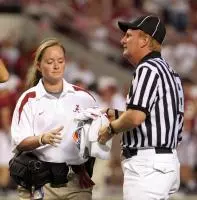
It takes only a quick glance on the Tide sidelines to realize this is one hard-working group on game day. They're the ones icing players, running water to the referees during timeouts, taping players, and generally keeping Bama's players game ready. They're among the first to arrive and the last to leave, a nod to just how fortunate the Tide family is to have these dedicated staff members.