Kimberley Ficenec: The 800-meter Life
5/29/2014 12:00:00 AM | Track & Field, Cross Country
May 29, 2014

By Pete LaFleur
For most collegiate athletes, their formative years on-campus, and the experience of being part of a team, symbolically create a "home away from home."
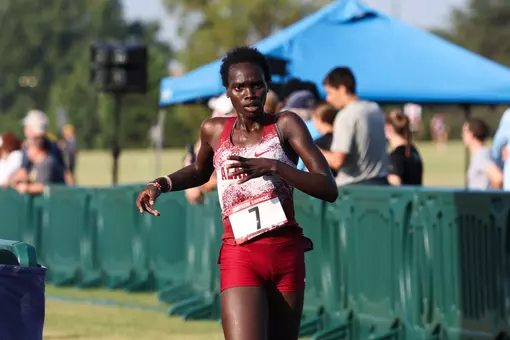
For Alabama sophomore Kimberley Ficenec, such a home away from home is her daily reality. Tuscaloosa essentially now is her home, and the promising middle-distance runner is starting to turn heads - particularly in her signature event, one of track and field's most rigorous tests, the 800 meters.
Since she first arrived at Alabama in the fall of 2012, Ficenec has navigated her young life without the benefit of having a parent as a regular presence in her life. There has been that inescapable void - nobody there to provide guidance and assistance with seemingly basic tasks, ones that most college students take for granted.
Ficenec's mother is remarried and lives in Japan, where her husband is stationed with the military. Kim and her mom now see each other once a year and remain in contact, as much as is possible from eight thousand miles away. Kim's father has been in and out of her life since she was four, when her parents - both natives of the Czech Republic - divorced.
Her story is both heartbreaking and uplifting. She is the kind of ambitious, good-hearted young person that one can easily root for.
Ficenec is one of 30 Alabama track and field athletes who will be competing this week (May 29-June 1) at the NCAA East Regional in Jacksonville, Fla., looking to advance to the NCAA Championships in a couple weeks. Her top 800-meter time this season (2:06.19) slots the Alabama sophomore firmly in the mix for earning a trip to Eugene.
She is intent on moving forward, an Olympic hopeful who has been forced to grow up quickly over the past two years.

The Ficenec kids used to spend several months each year in the Czech Republic, essentially splitting their early education between America and Europe. The family would stay with Becker's mother in DeÂ?ná, a small village in the South Bohemian region, closest to the Czech border with Austria.
Ficenec is not the first high-level athlete in the family. Both her parents had accomplished sporting lives back in the Czech Republic, as Zdenek at one point was that country's top-ranked pole vaulter while Hana rose as high as No. 2 in the national rankings for cross country skiing.
Older sister Blakeley competed in volleyball, soccer, track and field and cross country during her high school years. Blakeley most recently has been a member of the soccer team and a pole vaulter collegiately, at Cal State Los Angeles, where she just completed her junior year.
Hunter Ficenec is a promising middle distance runner but has limited high-end competition experience while living on the military base in Okinawa. The eldest of Ficenec's two half-brothers, Jakub Ficenec, is a professional hockey defenseman who played for Germany at the 2010 Winter Olympics.
"Seeing Jakub compete in the Olympics, I told myself that was something I want to do some day," Ficenec said. "It's something I want to shoot for."
As a seventh grader, Ficenec endured what turned out to be a transformative moment in her life, in the high school cafeteria of all places.
"My sister was really popular, so of course I wanted to be like her," Ficenec said. "One day I figured I had nothing to lose and asked my sister if I could sit by her at the 'popular table' during lunch."
It turned out, the younger Ficenec sister did have something to lose. Blakeley - who later apologized - rebuffed her sister, denying admission to the "cool people" zone.
"We all go through stages when we are young, and of course I forgave her for that," Ficenec said. "Over the next few days, instead of feeling sorry for myself, I built myself up from there. I did not care about being popular - that was not my goal.
"I told myself that I was going to set some goals, some dreams, and go after them. Things at home were not always the best, but it motivated me to run faster. People are not always going to be there for you, and now I am on my own. I don't know where I would be if I did not have what I have now at Alabama."
"I wanted to do everything my sister did, but none of it clicked," Ficenec said. "I finally found my niche as a runner, but even then I just assumed my best events were in the sprints."
As a high school freshman back in California, Ficenec began to envision herself as an elite 200- and 400-meter runner. After moving to Virginia, she was shocked back to reality.
"At the start of my sophomore year at Mountain View High School, coach Dave Davis made it very clear that I was not a sprinter but should be running the 800," Ficenec said. "I was worried. It seemed like such a long distance at the time."
It didn't take long for Ficenec to realize that "coach Davis was right all along." She indeed felt comfortable running the 800. Her athletic quest finally had found the ideal landing spot.
Ficenec made a splash during her junior season, first by winning the Virginia state title in the 1,000 meters, and then finishing as the state runner-up in the 800 outdoors - before impressively winning the 800, at the prestigious New Balance Outdoor Nationals.
One year later, as a senior, Ficenec turned more heads by posting a personal-best time of 2:06.84 in the 800, ranking as the nation's fifth-fastest high school time for that 2012 season. She won 2012 state indoor titles at two distances (800 and 1,000). When competition shifted outdoors, Ficenec flashed her special range - finishing as the state runner-up in both the 800 and 1,600 meters.
"I have grown to love the 800 because it is such a challenge," Ficenec said. "It's almost like a full-out sprint. You have to be running fast the whole time. I love just focusing on the two laps, and it's not too long, not too short."
At one point in her teenage years, Ficenec did not see her father for a period of nearly five years, as he was dealing with his own personal issues and was back in the Czech Republic for much of that time. In such instances, youth coaches often help fill the void.
"Coach Davis was like a father figure to me, in what was an important part of my life looking back at it now," Ficenec said. "He always believed in me, at a time when I easily could have lost so much confidence. He got me on track and motivated me to get somewhere and be somebody."
As the recruiting phase progressed, the Alabama coaching staff began to sense that the lanky, 5-foot-10 Ficenec was a good fit for their program. But they also knew that the promising middle distance runner was carving out her success on an unconventional path.
"We knew it would be a lot different because Kimmy was going to be on her own - hers was not the standard, cookie-cutter American life," Tribble said. "Kimmy had the talent and all the physical elements, including a great stride with very long legs. And we loved her tenacity, that drive she has.
"During the recruiting process, I really meshed well with Kimmy and that is very important to me as a coach. I was willing to do the extra work, being a bit more patient and more involved at times. It was not going to be as simple as it looked on paper - but we made it clear to Kimmy that we would be there to support her during the challenge of being on her own."
Alabama head coach Dan Waters said that many top women's distance runners simply are not good fits for his Alabama program.
"Our coaching staff has a saying that we are always going to get the recruits that we are supposed to get," Waters said. "As long as we are diligent and stay true to our philosophy, we are going to get the ones who are going to make our team better.

"Coach Tribble is a huge believer in making sure we have the right kind of individuals to match the culture we are trying to build in our program, and Kimmy was just such a match. We came to appreciate her dedication, focus and responsibility. She is a very positive, quality person."
Ficenec was originally uncertain about the prospects of attending college in the south, but she agreed to take a campus visit in mid-October of 2011. That visit coincided with the Alabama home football game against Tennessee. American football was essentially foreign to the young lady who had spent a good chunk of her childhood living overseas.
"I did not understand football at all," Ficenec said. "But I really liked the atmosphere and it was fun and exciting, even if I did not know what was going on."
Ficenec came away impressed with the Alabama campus, recalling how "everybody was so nice and always wanting to help you." She began to develop a bond with the Tide coaches.
"The coaches were rebuilding the program, but they assured me I would have these great teammates who I could run with and practice with," she said. "I trusted in the system and made a great choice to come to Alabama."
Aided by the old trusty one-two punch of southern hospitality and school spirit, Alabama had pulled off a major coup: signing one of the nation's top 800 runners, one of the more challenging spots to fill on any track and field roster.
"When Kimmy made her commitment, it was a big gain for the program," Tribble said. "It signaled to other recruits that there would be elite-level teammates here at Alabama. Kimmy signing was a big jolt to the program."
"Kimmy is coming into her own, starting to form her own identity - and it has been great to see that evolution," Tribble said.
"She is on her own now, not being forced into things or manipulated, but also not looking for handouts. That independence and maturity involves taking care of personal business on even the most basic level. We're talking about commonplace things that most college kids take for granted, because they have parents to fall back on and handle stuff."
Tribble noted that Ficenec "didn't even have a co-signer" when it came time to secure an apartment. She also initially did not have the foresight to make proper plans for attending summer school. Creating a personal budget and setting funds aside - it all was "learning on the job."
"Kimmy went from being all over the place as a high school senior to now having a good handle on things in terms of the big picture. I commend her for that personal growth, and I think we are going to see the fruits from all the work she has put in."
One example of Ficenec's on-the-job training as an independent 19-year-old came near the end of the 2013 college season. She failed to advance from the NCAA East Regional to the NCAA Championships, but her flight to Japan still was a couple weeks away.
After returning to campus from the regional, Ficenec had to move out of her dorm. But there was no Plan B.
That's when classmate and fellow middle-distance runner Katelyn Greenleaf stepped in. A resident of the same dorm, Greenleaf checked with her parents, received their OK, and then asked Ficenec - somewhat pleaded with her - to come and stay with her family in Florida for a couple weeks.
"Katelyn has a great family and Kimmy really enjoyed those two weeks, just relaxing in a loving family setting," Tribble said. "As a coach, of course you love to see members of your team looking out for each other like that."
Ficenec's well-travelled summer of 2013 included those two weeks in St. Petersburg, Fla., then visiting her family in Japan, followed by some time in southern California with an aunt and her sister, before attending a cross country camp back in Virginia, and then finally returning to Tuscaloosa.
"The 800 is one of the most rigorous events in track and field, because it combines the speed of a sprinter with the endurance of a distance runner, and you have to fuse that into a very special athlete," the third-year Alabama head coach said.
"Not only are the top 800-meter runners special, they are very specialized. The best coaches first find great middle distance runners, and then they have to figure out the best way to coach each of those individuals based on specific strengths and weaknesses. It becomes a real challenge."
Waters will concede that "God-given talent" is a first prerequisite for elite 800-meter success, while other key factors include "using oxygen, buffering lactic acid - the whole science part" of being a great middle distance runner.
"But, at the end of the day, the talent and the science don't matter if you aren't dealing with a special person who is competing in the 800 - A person like Kimmy," Waters said.
While the 800 is Ficenec's signature event, she is far from being a "one-trick pony." In fact, her running range is one the sophomore's greatest qualities. She can compete in the 1,500 while also anchoring the indoor distance medley relay (for the mile/1,600-meter final leg) and even running cross country (3-6 kilometers) in the fall.
"Kimmy is a very special athlete because of her range and ability to help the program in so many different events - that versatility is a huge part of what we are trying to do as a program," Waters said. "Coach Tribble is a master in the fall of making sure that Kimmy is a contributor in cross country while properly pacing her for the winter and spring track seasons."
Ficenec actually qualified for the 2014 NCAA East Regional in both the 800 and 1,500 meters (top time of 4:21.44), but the Tide coaches opted to direct her entire focus into advancing in the 800 this week.
A quick check of the updated Alabama record book reveals that Ficenec's top times in the 800 (2:06.19) and the 1,500 (4:21.44) both rank sixth in the program's history. Only two other Alabama women's runners - the legendary Evilyn Adiru (2:01.98; 4:09. 61) in the mid-1980s and Vicky Lynch (2:03.40, 4:17.19) in the early '90s -are currently among the program's top 10 in both the 800 and 1,500.
Waters minces no words when proclaiming "800-meter runners are the toughest kids to find in the recruiting process." Yet Alabama has two of the greatest 800-meter performers in program history - Ficenec and senior Yanique Malcolm - on the same squad.
While Ficenec and Malcolm share impressive 800-meter results, their running style and training regimen couldn't be any more different. Malcolm - whose school-record 2:03.28 places her among the nation's top 800-meter runners this year - is more of a sprinter, also excelling in the 400. Ficenec, of course, regularly runs the 1,500 but even can turn in quality 6K times during the cross country season.
Alabama's elite 800-meter duo does not train together. Malcolm, a native of Kingston, Jamaica, can be found training with sprints coach Matt Kane while Ficenec is with Tribble and his distance crew.
The pair do spend moments together when it comes time for the indoor distance medley relay, with Malcolm running the 800 while Ficenec handles the anchor mile leg.
"We train Kimmy and Yanique completely differently," Tribble said. "They are a total contrast in styles - it is like totally different types of famous artists. Kimmy has the tools to do whatever we need. We don't know where that is going to be best and we don't really care, as long as we use her in the best area where she can excel."
The Alabama track and field record book is filled with women's middle distance marks from the 1980s and early '90s. Those records remain impressive times to this day.
"That stellar era of Alabama women's middle distance corresponded with my own college running career - and Alabama middle distance definitely set the pace for the entire nation at that time," Waters said. "In the late 1980s and early '90s, Alabama was absolutely the program that everybody aspired to be."
At the Alabama Relays home event earlier this season, one such early-1990s legend, Vicky Lynch Pounds, served as the guest speaker. "It's important for our current team members to connect with that great past," Waters said.
"That meet was a very big stage for Kimmy, especially as a freshman," Waters said. "When she ran that great qualifying time, we all looked around at each other and were super excited. We knew we had a pretty special young athlete on our team - the kind that you can build your program around."
Ficenec admittedly is not one to get out and be the pacesetter in the 800. She typically looks to find a good tempo and rides it from there.
But what she is known for is this, a devastating finishing kick.
"One of the things that makes Kimmy unique is that if she is in the race, she is really tough to beat," Waters said. "If she is in touch with the leader, she has that really good leg speed and ability to close - or, as we like to say, finding the finish, closing the door."
Ficenec typically bides her time, before pouncing to slam that door.
"I always am confident that I have that kick in me coming down the stretch," she said. "I ask myself 'Do you have more to give?' And the answer is always yes. You always have more to push.
"When I am there in position and have that kick, I feel you can't stop me."
"Consistency for Kimmy is the biggest thing right now, having better focus and not taking a lap off, or a day off," Tribble said. "That effort needs to be there all the time and she needs to work through things by compartmentalizing and not letting anything fester.
"Kimmy is at her best when she addresses things that need to be addressed while not addressing things that don't need to be addressed."
Waters pointed out that the trait which sets apart the great middle distance runners is the ability to "repeat at a championship level." At the SEC and NCAA meets, an 800-meter runner first has to qualify into the final, and then needs to match that time (or better) in the championship race.
"It's all mental, because at this point I have everything from a physical and training standout," the sophomore said. "I have to work on my mindset, because that is what you do on your own. You have to get ready picturing yourself in the race, go through the scenarios and get your head in the game. It's a huge part of it."
"We ask all of the members of the team to keep in touch during the summer, but it's usually basic conversation, update stuff," Waters said. "With Kimmy, we talked that day mostly about life. What she was thinking, where she saw herself going over the next few years."
Of course, there also were some quality minutes discussing their common passion: the 800 meters.

"Coach Waters used to be an 800 runner too, and he tells me stories about his own races and gives great insight into the event," Ficenec said. "He is a great communicator and can tell me things in ways that I can relate to. He knows what I am going through and has that connection, that same mentality.
"It's special to have a head coach who still has those specific links to the sport and that connection with his athletes. I really appreciate how he always reinforces to me that I have what it takes to be a good runner but just have to believe in myself to take that next step."
On a more regular basis, Ficenec has benefitted from Tribble's steady encouragement and guidance, including at their weekly 1-on-1 meetings.
"I respect coach Tribble so much as a coach," Ficenec said. "I know that he believes in me and all of our workouts are always on point. He is very upbeat, excited for our success and always is providing positive feedback."
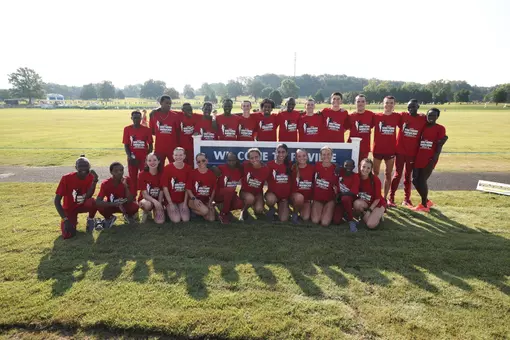
"I feel like I have a huge family on my team here at Alabama and we all are very close," Ficenec said. "It makes me feel like I am at home. I am here, and I don't need anything else. I feel safe and feel like I have people who enjoy my company. I am doing well and like everyone around me. Life is good."
That sense of community is a central tenet of the program that Waters set about building, back in the summer of 2011.
"Even though we are an individual sport, there are numerous team concepts that go into the daily lives of our cross country and track and field athletes," Waters said. "Every individual always is adding something to the process. In cross country, we are only going to be as good as our fifth runner - and a similar philosophy applies to our overall program success in track and field."
Shortly after settling in at Alabama in the fall of 2012, Ficenec joined a group of cross country/middle-distance runners that included no true established veterans (outside of Malcolm, who of course is more of a "sprint" middle-distance runner). Ficenec and four fellow freshmen formed the core of the cross country team back in the fall of 2012, and they were the bulk of the primary middle-distance runners when the 2013 track season rolled around.
Ficenec and her four middle-distance classmates are an eclectic collection in terms of geographic origin. In addition to Ficenec's Czech Republic-California-Virginia hybrid, Greenleaf hails from Florida. Susie Kemper is Texan. Rebecca Stover call Tennessee home, and Meropi Panagiotou - whose name now appears in several Alabama top-10 career lists - hails from Nicosia, Cypress.
During that class-bonding freshman year, three of those newcomers - Ficenec, Greenleaf and Panagiotou - all qualified for NCAA postseason competition.
"When Kimmy and those other middle-distance girls were freshmen, they really had no established veterans to show them the ropes," Tribble said. "They had to learn it all by themselves, meet by meet, wondering what in the world was going on.
"That is a really tough learning experience for a distance runner, but Kimmy and her classmates will be the better for it later. It was a very unique and rare challenge."
Looking back, Ficenec's experience as one of those freshmen without the benefit of veteran leaders mirrored her personal situation: starting college on her own, without regular parental guidance.
Ficenec even had to pack away parts of her life - literally - when she came to Alabama at the start of her freshman year. Her family already had moved out of their home and would be heading to Japan, shortly after dropping off her in Tuscaloosa.
Although Ficenec brought numerous belongings with her to college, plenty of other valued items and keepsakes are gathering dust in long-term storage. There's an art set, part of a "little hobby" in high school that allowed Ficenec to explore her creative side through painting. Photo albums and other such items, for now, are not easily accessible.
With so much promise in front of her, that of course is where Ficenec has directed her focus: ahead.
"I like to stay positive, upbeat and motivated, and I'd like to think I am always hopeful," she said. "I've had a rough past, but I try not to think about it a lot and try to not let the negative stuff get to me.
"I use my past for a purpose, and it got me to where I am now. Every time I have been pushed down, I always get back up. It all brought me here to Alabama."
One thing seems clear: the 800 meters truly is Kimberley Ficenec's signature event and seemingly a microcosm of her own life:
"In the 800, I always tell myself to run the first lap with my mind and then the second one with my heart. It works out that way for me," Ficenec said. "The first lap is tough, because you are just sprinting and then have to try and hold it for the second one.
"But during that last lap, you are dying and hurting. You just have to dig deep and find a way to get that kick, and finish it."