Green's Principles Lead Volleyball Turnaround, Program Success
4/28/2008 12:00:00 AM | Volleyball
April 28, 2008
By Scott Latta
UA Media Relations
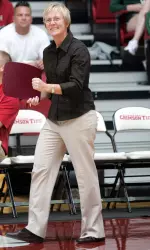
When Judy Green was hired in 1996 as the head coach of the Alabama volleyball team, she wanted to get a better idea of what she would need to focus on while rebuilding the program. The best way to do that, she figured, was to take inventory of what she already had. So, early on, Green first took a systematic look at what she was inheriting.
The answer, she found, was not much. Despite coming off a 24-10 season the year before, Green saw a program in need of organization, structure, discipline and accountability from top to bottom.
"When you inherit a program, as I did here in 1996, you walk in and you have to make an evaluation of where you are and what is reality," Green said. "Reality was that our program was in a total state of disorganization."
Laying the Foundation
One of the first things Green did as coach was instill a three-point focus to get the program turned in the right direction. The first was discipline and accountability, in the weight room, the gym and the classroom. The second was clarifying what her expectations for her teams would be and the standard to which the Alabama volleyball program would be held. The third was reinvigorating the team with passion and enthusiasm that was notably missing from the program.
It was a bold move for the new coach on campus, whose previous coaching job was of the Division II Montevallo Falcons. Green, however, was steadfast and confident in her judgment of the program.
The result: in her first season, Alabama compiled a 5-31 record, going 1-24 in road and neutral-site matches.
"We took some big lumps that first year," Green said. "It wasn't surprising. That was by far the most difficult schedule we've played in 12 years. There were a lot of tears and a lot of conversations and a lot of emotion during that first year."
Alabama's disappointing .139 winning percentage during Green's first season did little to rattle the coach. Amidst the turnover that had plagued the program the previous year, Green remained a constant in the gym, and her principles began laying the foundation for the turnaround of the program.
In 1997, Green's second season as coach, Alabama won nine matches, improving its record away from Tuscaloosa to 7-12. The next year, Alabama won 14 games, then experienced its first winning season under Green in 1999, with a 17-15 record.
But the culminating moment for Green came in 2000, when Alabama captured the SEC Western Division title with a 22-8 record, a .733 winning percentage, and finished with winning records at home, on the road and at neutral sites. The Division Champion trophy sits in Green's office today.
"I couldn't be more proud of that first group because they truly were the ones who scraped the road for everyone else," she said. "Unfortunately, we did have to go through it. But I'm not sure had we not gone through it that we'd be as successful as we are today."
`The Culture Has Changed'
Since the 2000 Western Division title, Green has led Alabama to a winning record in every season, repeating the 2000 feat with a share of the Western Division Championship in 2005. The 2008 team will be looking for its fourth consecutive trip to the NCAA Tournament, which also would be the fourth in school history.
The recent success of the program has made for an environment drastically different than the one Green walked into in 1996. But, despite changes in environment and attitude, Green says the principles that helped form the initial foundation of the program remain relevant today. Also similar are the goals for the program, which remain the same each year, despite the record of the previous season.
"Every year we have to evaluate our team for who they are, and it's really easy to compare this team to another team in the past, but the expectations will always be the same," she said. "We always have the same goals: to compete for the Southeastern Conference Championship and to get into the NCAA Tournament and advance as far as we can go. Those goals will never change. The culture has changed, to a degree. But once you become more successful, the expectations start to escalate."
Growing expectations surrounding the program have led to a trickle-down effect that has reached all the way to the recruiting trail. Until recently, the approach of the Alabama coaching staff in regards to recruiting has been to reach out to the raw volleyball player and help her develop during her four years at Alabama. Now, the program has enough to offer to attract the elite-level volleyball player and help her mature during her time at Alabama.
Also changing, Green said, is the mindset of the players already on campus - a mindset that is not centered on living up to the success of previous teams, or on anticipating future success, but focusing on the season at hand.
With a 2008 roster that will be without four of the most successful seniors in the program's history - Bridget Fuentez, Crystal Hudson, Megan Hudson and Brigitte Slack - Green knows that this approach has suddenly become even more important for what will be a very young team.
"Part of our growth process right now is getting our youngest team in several years now to understand how to work with the expectations, to work within themselves, to make it just about them right now," Green said. "It's their team at this time, and not the team from a year ago or the team two years from now. It's this team.
"And they all have the desire to continue the team's success, it's just a matter of learning how to handle success and expectation while continuing to raise the bar."
Looking Forward
The Alabama administration showed Green recently that it had confidence in her direction of the program when Green was offered a three-year contract extension, effective January 2008, which will take the Alabama coach through the 2010 season. But even with all the resources given to Green and her program -- including the construction of the CAVE (Coleman Auxiliary Volleyball Extension) in 1996 and the recent renovation of Coleman Coliseum -- Green said that what makes Alabama a special place to coach are the people behind the scenes, who ensure that all resources are available to make all athletes at the University as successful as possible, both in and out of the arena.
"Coming here in 1996 from such a close-knit school, where everybody knew everybody, my relationships with the people at the University of Montevallo were very close with Deans of departments, and I didn't know if that could exist at Alabama," Green said. "I found out very quickly that it can.
"We have the best strength coach, the best academic advisor, the best graduate assistant trainer, we have the best of the best that the university has to offer to mentor our volleyball players on a daily basis. A building looks great and helps in recruiting, but it's (all about) the people. It's Mal Moore, and Mal Moore's commitment to putting the people in place for us to have a beautiful volleyball facility and one of the nicest weight rooms in the country."
When Judy Green thinks about her best day as Alabama's volleyball coach, she pauses. There have been many to ponder. Eventually she settles on two: the first is every day she sees her players graduate and walk across the stage in Coleman Coliseum with a degree, knowing they are older, wiser and more mature having been members of the volleyball program.
Then she looks at the 2000 Western Division Championship trophy that sits in her office. That was a special moment, she says. That was when her first full recruiting class brought its hard work in those first years to fruition and left the University with a championship.
It was when the principles Green had laid out years before proved effective, and when the memories of that first five-win season were drowned in a year the Crimson Tide won 22.
It was when, for the first time, she was really able to show everyone her program was on the move.
"It was like, OK, we're going places," she said. "Now we're going places."